THE SCIENCE BEHIND LIFESCOZUL

A scientist.
A question.
Two decades
of discovery.

What can blue scorpion venom teach us about cancer biology?

Meet Dr. Alexis Díaz-García and explore the research behind Grupo LifEscozul.

Explore the science ↓Your questions, answered
Dr. Alexis Díaz-García, Grupo LifEscozul researcher
GRUPO LIFESCOZULDr. Alexis Díaz-García

Director of Research & Development

BLUE SCORPION VENOM / CANCER BIOLOGYFollow the research ↓
20Years of scientific research
16Scientific publications
2International patent applications
One focus.Understanding venom and its components

01 / THE PUBLISHED SCIENCE

Discovery begins
with evidence.

From ion channels to cancer-cell responses, each study examines a different part of the question.

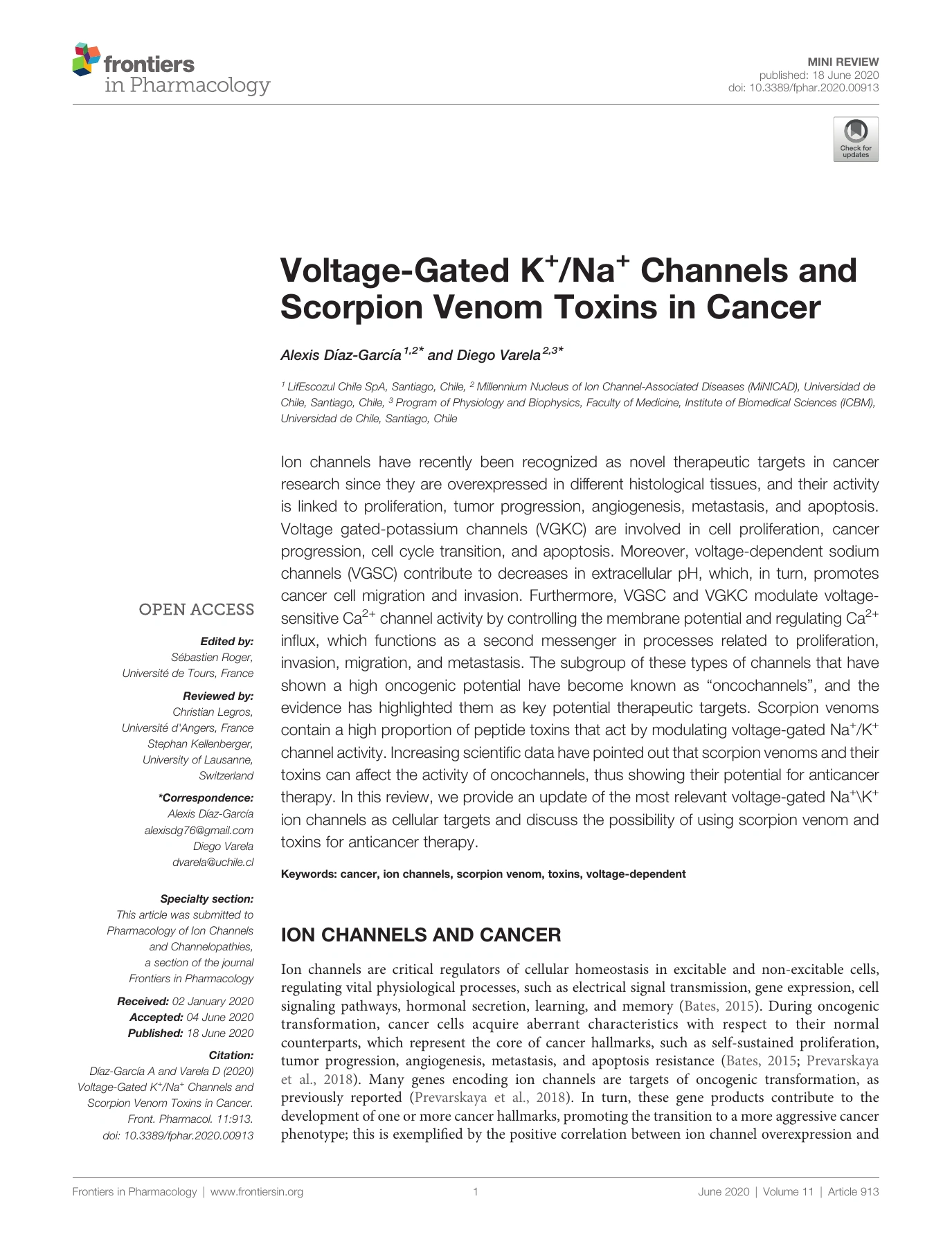
Original first page of the Frontiers in Pharmacology review on ion channels and scorpion venom toxinsRead original paper ↗

2020 / RESEARCH REVIEW

Ion channels.
A biological starting point.

A review of potassium and sodium channels in cancer biology and the potential of scorpion toxins to investigate these targets.

Frontiers in Pharmacology
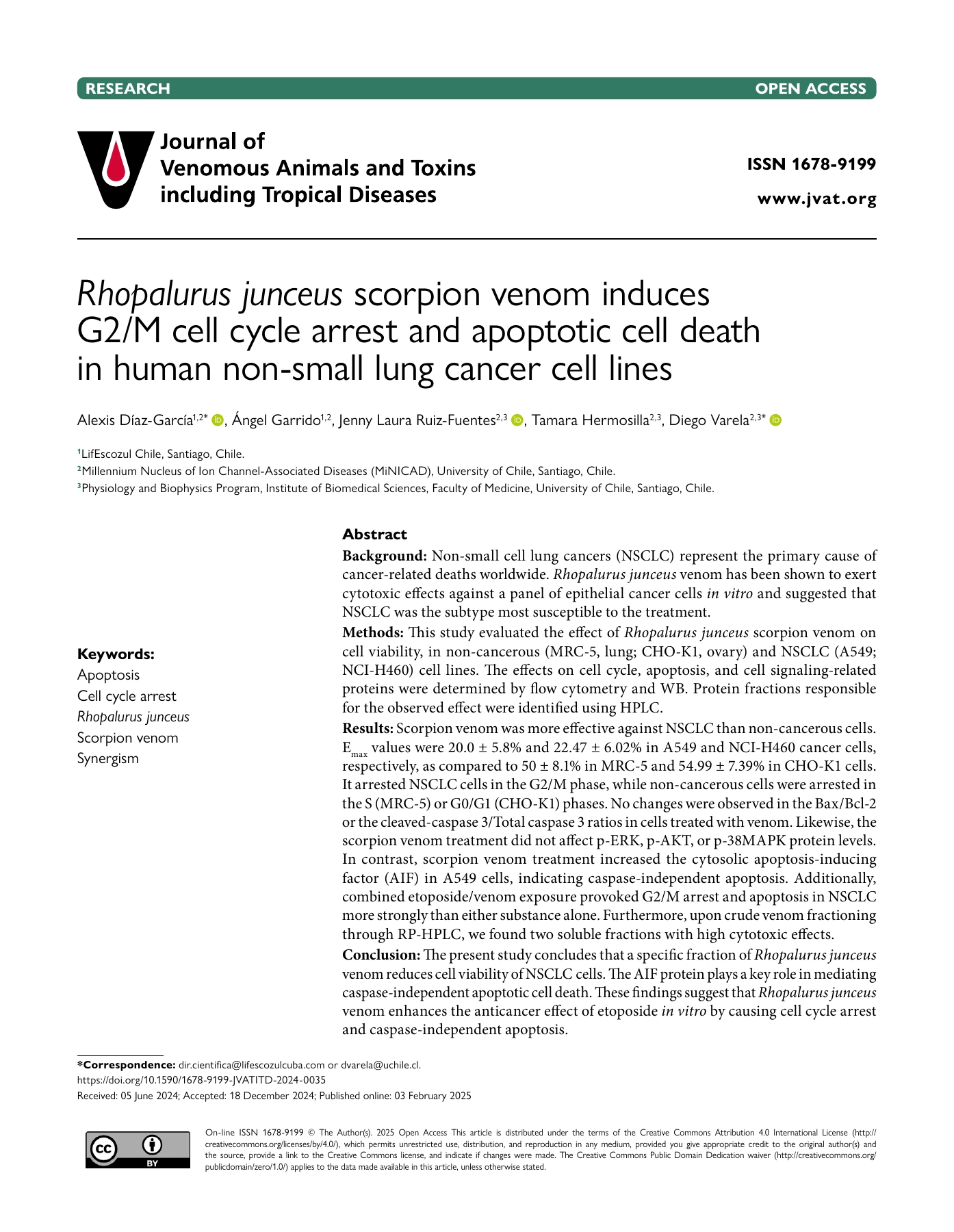
Original first page of the 2025 experimental lung cancer studyRead original paper ↗

2025 / CELL-CULTURE STUDY

Cell-cycle arrest.
Apoptotic cell death.

Experiments with A549 and NCI-H460 lung cancer cells reported G2/M arrest and apoptosis following exposure to venom.

Journal of Venomous Animals and Toxins including Tropical Diseases
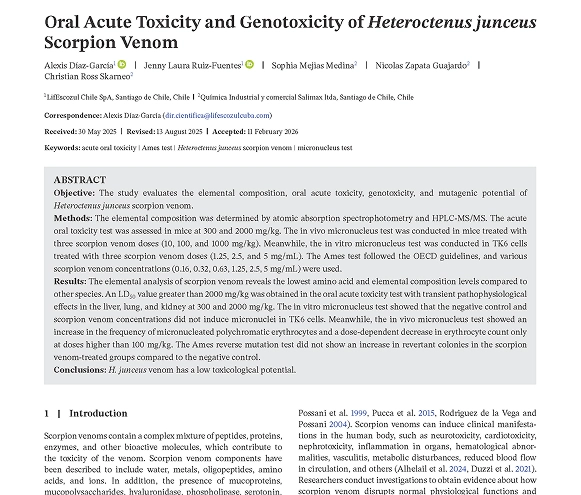
First-page excerpt of the 2026 oral acute toxicity and genotoxicity paperRead original paper ↗

2026 / PRECLINICAL TOXICOLOGY

A closer look
at toxicology.

Research into oral acute toxicity and genotoxicity adds another dimension to understanding blue scorpion venom.

Veterinary Medicine and Science

Selected publications. Each finding belongs to the material and experimental model studied.

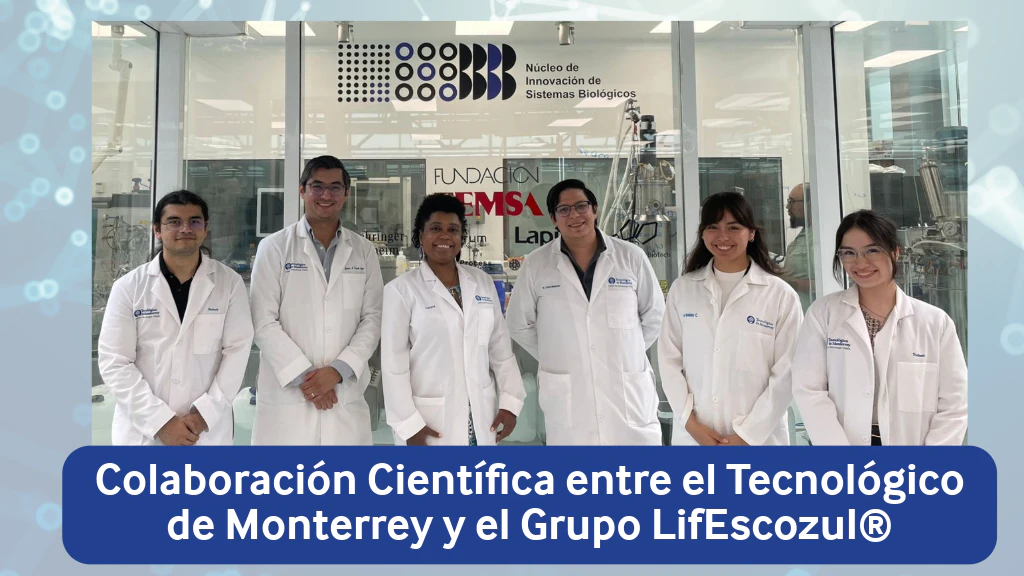
Researchers from the Tecnológico de Monterrey and Grupo LifEscozul collaborationSCIENCE IS A COLLABORATIVE EFFORT.

02 / THE PEOPLE & THE PARTNERSHIPS

Behind the research,
a scientific team.

Grupo LifEscozul studies blue scorpion venom, its fractions and individual components to understand their biological activity and explore future applications in oncology.

Our work connects laboratory research with academic collaborations and preclinical evaluation.

03 / FROM FINDINGS TO INVENTIONS

A complex venom.
More precise questions.

Two published international patent applications document complementary directions in our research.

Conceptual illustration of components within venom

01 / VENOM FRACTIONS

Separating the mixture.
Studying the components.

Pharmaceutical compositions based on different fractions of blue scorpion venom.

WO2025241039A1 ↗
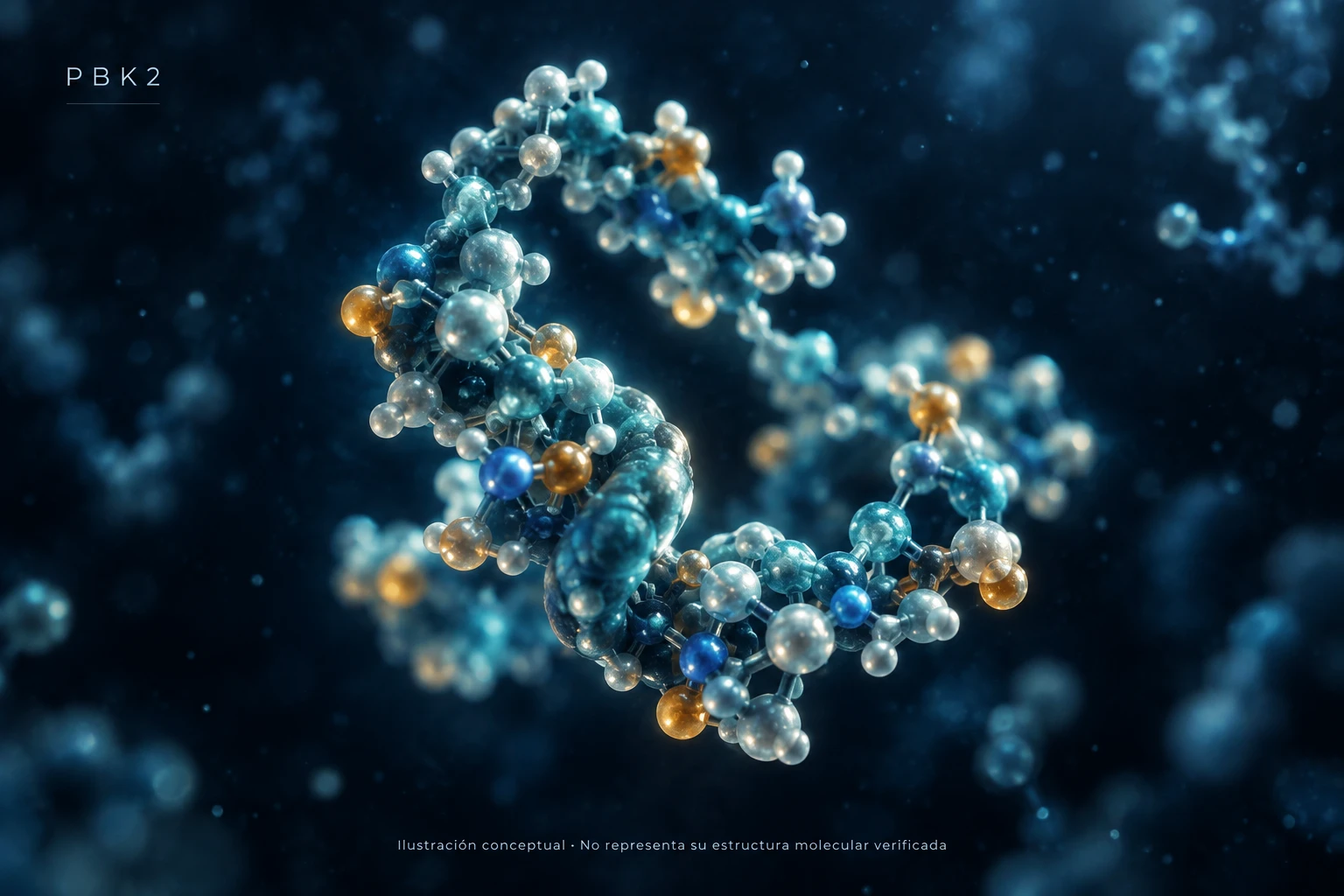
Conceptual peptide illustration, not a resolved molecular structure

02 / PEPTIDE RESEARCH

PBK2.
A molecular research direction.

Venom-derived peptides, variants and compositions, with migration and invasion investigated in laboratory cancer models.

WO2025241040A1 ↗

What makes a peptide worth investigating?

Conceptual illustrations. These are published applications, not representations of granted patent status.

Conceptual presentation of an Escozul bottle
Conceptual product presentation.

04 / OUR PRODUCT

Meet
Escozul®.

The product within the LifEscozul story.

Developed from our work with blue scorpion venom, Escozul sits alongside a continuing research program and a team dedicated to information and support.

NDC listed

Listed in the FDA’s National Drug Code Directory. Listing is not FDA approval.

Research, explained

Escozul is our product. PBK2 is a component within a specific research line. Experimental findings do not automatically establish the product’s clinical effects.

Learn more about Escozul® ↗

05 / SCIENCE WITH A HUMAN CONNECTION

Questions deserve
a conversation.

Our team helps people understand our work, learn about our product and navigate the next steps.

01

Information.

Ask about the research, the publications and Escozul.

02

Guidance.

Understand how our evaluation and support process works.

03

Follow-up.

Stay in contact with the team throughout your experience.

Read a published community experience ↗

06 / FREQUENTLY ASKED QUESTIONS

Understand
the science.
Know the people.

Start with the venom. Meet the researcher. Understand our approach and our product.

Conceptual illustration of the components inside a venom droplet
A COMPLEX MIXTURE.
A PRECISE SCIENTIFIC QUESTION.
Explore the references ↓
01

What is blue scorpion venom?

A naturally occurring mixture of biologically active molecules produced by the Cuban blue scorpion. The species appears in the scientific literature as Rhopalurus junceus, also known as Heteroctenus junceus.

Its venom contains peptides, proteins and other components. Scientists study the whole venom, separated fractions and individual molecules to understand how each interacts with biological systems—including cancer-cell models.

Whole venomFractionsPeptides

This is why the exact material and experimental model matter: findings about one fraction or peptide do not describe every venom-derived product.

Scientific context: 2025 cell-culture study [1] · 2020 ion-channel review [2] · 2026 toxicology study [3]

02

Who is Dr. Alexis Díaz-García?

Dr. Alexis Díaz-García
Dr. Alexis Díaz-GarcíaDirector of Research & Development
Grupo LifEscozul

Alexis is a researcher with a doctorate in Pharmaceutical Sciences and a master’s degree in Experimental Pharmacology from the University of Havana. His background also includes microbiology and postdoctoral work at the University of Chile.

His research explores the biological activity of blue scorpion venom, cancer-cell responses and molecular mechanisms. He is an author of the ion-channel review and experimental lung-cancer study featured on this page.

Background: Official scientific biography [4] · Published work: [1] [2]

03

What makes Grupo LifEscozul different?

Our approach brings scientific research and personal support together. We investigate blue scorpion venom and its components while helping people understand our work, our product and the process of engaging with our team.

THE SCIENTIFIC SIDEResearch you can explore.

Published studies, academic collaborations and patent applications with original documents you can read.

THE HUMAN SIDEA team you can talk to.

Answers to questions, guidance through the evaluation process and ongoing communication and follow-up.

That combination—research, product information and accompaniment—defines how we work with our community.

Explore: Academic collaboration [5] · Our services [6] · Patent applications [8]

04

What is Escozul®?

Escozul® is Grupo LifEscozul’s product derived from blue scorpion venom. The U.S. label describes an alcohol-free homeopathic liquid taken orally, containing blue scorpion extract at a 6X homeopathic dilution and labeled for general well-being.

Its U.S. label is available through DailyMed under NDC 87019-001-01. This listing identifies the product; it is not FDA approval.

Escozul is the finished product. PBK2 is a peptide within a specific research line. The venom and fractions examined in laboratory studies are not interchangeable with the finished formulation.

Our team can explain the product information and the support services available to you.

Product reference: U.S. product label on DailyMed [7]

Ask our team about Escozul ↗

READ THE ORIGINAL SOURCES

Evidence.
With references.

Scientific papers, institutional information and product documentation—each with its own role in the story.

[1]
PEER-REVIEWED / IN VITRO · 2025

Cell-cycle arrest and apoptosis in lung cancer cell lines

Díaz-García et al. Journal of Venomous Animals and Toxins including Tropical Diseases.
DOI: 10.1590/1678-9199-JVATITD-2024-0035

Read the study ↗
[2]
PEER-REVIEWED / REVIEW · 2020

Voltage-Gated K+/Na+ Channels and Scorpion Venom Toxins in Cancer

Díaz-García & Varela. Frontiers in Pharmacology.
DOI: 10.3389/fphar.2020.00913

Read the review ↗
[3]
PEER-REVIEWED / PRECLINICAL · 2026

Oral Acute Toxicity and Genotoxicity of Heteroctenus junceus Scorpion Venom

Díaz-García et al. Veterinary Medicine and Science.
DOI: 10.1002/vms3.70872

Read the study ↗
[4]
SCIENTIFIC BIOGRAPHY / GRUPO LIFESCOZUL

Dr. Alexis Díaz-García

Education, scientific experience and research background, as described by Grupo LifEscozul.

Read his biography (Spanish) ↗
[5]
INSTITUTIONAL REPORT / TEC DE MONTERREY

Academic collaboration in Mexico

Tecnológico de Monterrey’s report on its scorpion-venom research collaboration.

Read the report (Spanish) ↗
[6]
SERVICE INFORMATION / GRUPO LIFESCOZUL

Evaluation, guidance and follow-up

Grupo LifEscozul’s description of its services and the process for people interested in its program.

Explore our services (Spanish) ↗
[7]
PRODUCT LABEL / DAILYMED

Escozul® · NDC 87019-001-01

U.S. product labeling, ingredients and listing information. DailyMed is hosted by the U.S. National Library of Medicine.

Read the U.S. label ↗
[8]
PUBLISHED INTERNATIONAL PATENT APPLICATIONS

Venom fractions and peptide research

Original application documents describing the claimed inventions and their research context.

WO2025241039A1 ↗WO2025241040A1 ↗

START A CONVERSATION

Learn more.
Ask our team.

Whether your question begins with a publication or with Escozul, we’re here to help you understand.

servicios@lifescozulcuba.com

What would you like to know?

This opens your email application with a draft you can review before sending. This page does not store your information.

You can also email servicios@lifescozulcuba.com.

GRUPO LIFESCOZUL / RESEARCH NOTES

PBK2: migration and invasion.

PBK2 is a peptide identified through research into blue scorpion venom. The patent application describes peptides capable of decreasing hKv1.1 potassium-channel activity and inhibiting migration and invasiveness in laboratory small-cell lung cancer models.

What is being investigated?
Cell movement and invasion—experimental endpoints relevant to cancer biology.
What does this establish?
A preclinical research direction. It does not establish that PBK2 prevents metastasis in people.

The 2025 lung-cancer publication examines venom in non-small-cell lung cancer models; it should not be read as a clinical study of PBK2 or Escozul.

Read the peptide application ↗

GRUPO LIFESCOZUL / RESEARCH NOTES

Two applications. Different research scopes.

WO2025241039A1 concerns pharmaceutical compositions based on fractions of blue scorpion venom.

WO2025241040A1 concerns venom-derived peptides, variants, compositions, methods and uses.

These are published international patent applications. Publication documents the claimed inventions; it is not a grant of a patent or a demonstration of clinical efficacy.

Fraction-based compositions ↗Peptides and variants ↗

GRUPO LIFESCOZUL / RESEARCH NOTES

Breast cancer cells: apoptosis in vitro.

Model: the human triple-negative breast cancer cell line MDA-MB-231.

Reported finding: apoptosis following exposure to Rhopalurus junceus venom in laboratory conditions.

This is cell-culture evidence, not a patient trial.

Rhopalurus junceus scorpion venom induces apoptosis in the triple negative human breast cancer cell line MDA-MB-231. Journal of Venom Research, 2017.

Read the original publication ↗

GRUPO LIFESCOZUL / RESEARCH NOTES

Lung cancer: looking at how cells respond.

Experimental models
A549 and NCI-H460 non-small-cell lung cancer cell lines, compared with non-cancerous MRC-5 and CHO-K1 cells.
Methods
Cell-viability assessment, flow cytometry, Western blotting and HPLC fractionation of the venom.
Reported findings
G2/M cell-cycle arrest and apoptotic cell death in the cancer-cell models. Increased cytosolic apoptosis-inducing factor (AIF) in A549 cells supported a caspase-independent pathway.
Why fractionation matters
Two soluble fractions showed high cytotoxic activity in the experiments, helping narrow the search for active components.

These findings concern experimental venom exposure in cell cultures; they are not clinical outcomes.

Díaz-García et al. Journal of Venomous Animals and Toxins including Tropical Diseases (2025). DOI: 10.1590/1678-9199-JVATITD-2024-0035.

Review methods and results ↗

GRUPO LIFESCOZUL / RESEARCH NOTES

A research program built on collaboration.

Grupo LifEscozul investigates blue scorpion venom, its fractions and specific components through laboratory studies and preclinical evaluation.

Our work connects biological questions with experimental approaches: identifying components, studying cancer-cell responses and assessing toxicological properties.

Research collaborations include Tecnológico de Monterrey in Mexico and Universidad de Chile. The 2025 lung-cancer paper lists affiliations with LifEscozul Chile, the University of Chile and the Millennium Nucleus of Ion Channel-Associated Diseases.

Read the Tec’s own report ↗Our research collaborations ↗

GRUPO LIFESCOZUL / RESEARCH NOTES

Escozul, PBK2 and the research program.

Escozul® is our product. PBK2 is a peptide within a specific line of research. Whole venom, separated venom fractions, isolated peptides and the finished product are different research subjects.

Experimental findings must be interpreted in relation to the material, dose and model actually studied; they cannot automatically be transferred to Escozul.

Escozul is listed in the FDA’s NDC Directory. An NDC listing is a product-listing record, not FDA approval or proof of effectiveness.

Our team can provide product information and explain the scope of our support services.

GRUPO LIFESCOZUL / RESEARCH NOTES

Eberto Gómez · Mexico.

Read Eberto’s published personal account and the context of his experience with Grupo LifEscozul.

Read his story ↗

Personal accounts are distinct from controlled clinical evidence and cannot establish treatment effects.

GRUPO LIFESCOZUL / RESEARCH NOTES

Ion channels: a biological rationale.

This review examines voltage-gated potassium and sodium channels in cancer biology and discusses scorpion venom toxins as tools for investigating these targets.

Research focus: the relationship between channel activity and processes such as proliferation, migration and invasion.

Evidence type: a review of published research, not a clinical trial or a direct test of Escozul or PBK2.

Díaz-García A, Varela D. Voltage-Gated K+/Na+ Channels and Scorpion Venom Toxins in Cancer. Frontiers in Pharmacology 11:913 (2020). DOI: 10.3389/fphar.2020.00913.

Read the review ↗

GRUPO LIFESCOZUL / RESEARCH NOTES

Toxicology is part of the research.

Oral Acute Toxicity and Genotoxicity of Heteroctenus junceus Scorpion Venom examines toxicological questions in preclinical models.

Research focus: acute toxicity following oral exposure and genotoxicity—whether exposure can damage genetic material.

These endpoints add a different dimension to the research program. Preclinical toxicity data do not establish safety or an appropriate dose for patients.

Díaz-García et al. Veterinary Medicine and Science (2026). DOI: 10.1002/vms3.70872.

Read the publication ↗